
TIME AND SPACE
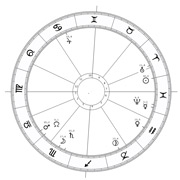
The foundation of astrology is the horoscope, or in its original meaning, the hour-watching (from Greek ὥρα "hour" and σκοπέω "to observe").
The horoscope is a mathematically calculated, graphical representation of the positions of the planets as seen from Earth. The positions of the Sun, Moon and planets are measured and described in relation to the zodiac.
It is a profound insight that the relationships between heaven and Earth can be represented and interpreted. Humans become aware of their spatial and temporal limitations on Earth, in contrast to the unlimited, immeasurable movements in the sky. Humans encounter the numinous, the seemingly ineffable, and can translate it into a simple diagram such as the horoscope.
In grasping astronomical phenomena, rhythms and cycles, the search for the constant within change continues.
By measuring time at a location, the repetitive and constant becomes determinable. Already in early human history, the workings of primordial and natural forces of creation were recognized in the movements of the planets and addressed by divine names. Thus Jupiter, Venus or Saturn received their place in the sky.
This achievement of putting the measure and characteristics of time into words represents one, if not "the" fundamental cultural achievement of humanity.
The historical-astronomical observations of the Sun, Moon and stars, or the measurement of time, therefore go beyond the purpose of a sowing calendar or the determination of harvest cycles and feast days, as interpreted in cultural studies.
FUNDAMENTALS
ZODIAC
The zodiac, as seen from Earth, is the apparent path of the Sun. This circular path is divided into twelve zodiac signs (Latin zodiacus, Greek ζῳδιακός, zodiakós). These zodiac signs, as a division of the Sun's path and the year, are a measure of time on Earth. The foundation of this division of the Zodiacus was documented by the Sumerians around 3,000 years ago. This discovery must certainly be dated even earlier.
The constellations of astronomy, on the other hand, are a different kind of division of the sky. Here various configurations of fixed stars are taken, such as the "Great Bear" or the "Big Dipper", and represent a spatial division of the starry sky.
Especially in the 19th and 20th centuries, an astronomical form of professional astrology developed that adopts a scientific approach using statistical methods and astronomical correlations. This is not trivial, but problematic when it pushes the interpretation of time-structural meaning contexts into the background.
Astra inclinant, non necessitant – "The stars incline, they do not compel." There is truth in this well-known saying from medieval astrological understanding. The stars do not force; they leave that to others.